

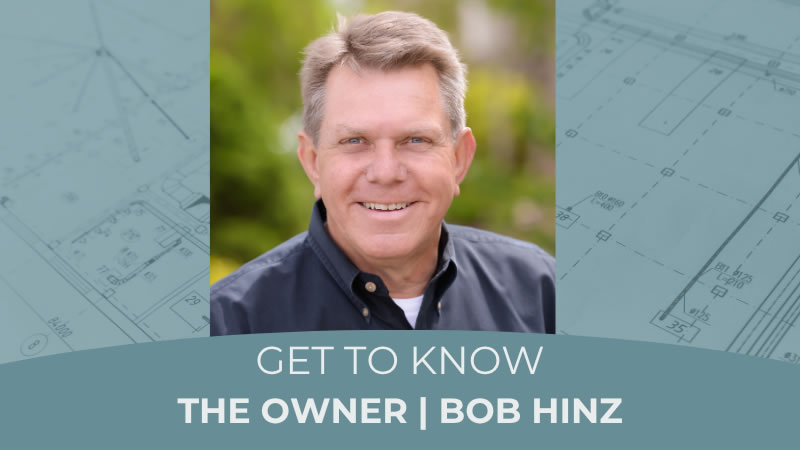
Bob Hinz grew up watching his father turn ordinary lumber into things people remembered for the rest of their lives. Then he did everything he could to stay out of the family business: graduate school, logistics, years on the road as a consultant. One day he came home and asked his wife Mary to back him in starting a company. That company was HomeWrights, and it has been guiding Colorado homeowners through custom builds since 2002.
We sat down with Bob to talk about the clients he still thinks about, the cliff-side build nobody has forgotten, and why he is so stubborn about handing homeowners the wheel.
A stair rail in Evergreen
Ask Bob for his earliest memory of a job site and he goes straight to his dad’s hands. “Dad was an amazing craftsman,” he says. “What fascinated me then still fascinates me today: the fact that a skilled craftsperson can make something so difficult look so easy.”
The memory is a set of handrails on a custom home in Evergreen. Bob was the helper, which meant fetching tools and cleaning up. Mostly it meant watching. “He turned ordinary wood into something so extraordinary. Like any terrific tradesperson, his mind was several steps ahead of what his hands and tools were doing.”
That turned into something close to an operating principle. When Bob talks about hiring trades, he does not talk about rates. “You have to identify and buy the whole package: hands, tools, mind and heart. Sometimes owners gravitate to the cheapest bid, but we always try to make sure they’re considering all aspects.”
And it is not just carpentry. “A great excavator can really amaze you with the precision he or she can accomplish with a 20 ton hydraulic shovel. I’ve seen them scrape half of an inch off of the wall of an excavation. Absolute surgical precision.”
The long way around
Here is the part that surprises people. “I was absolutely determined to NOT be a homebuilder,” Bob says. “As much as I admired my parents for running a custom home business, it’s an up and down life. The construction markets always have boom and bust cycles.”
So he took the long way around: forest products logistics, graduate school, consulting. Years on the road, millions of miles. “Oddly, the gravity of home building pulled me back in. I just came home one day and asked Mary to support me in a self employment venture. We started HomeWrights.”
What got hold of him was never the business side. “This sounds really goofy, but the sounds, sights and smells of construction are captivating. Fresh cut lumber, even freshly poured concrete, or fresh paint, those are terrific smells. Sawdust on your skin or hair? That’s the best kind of dirt! And watching something take shape with the awareness that you’re guiding the whole thing, that’s really special.”
Why HomeWrights exists
The detour turned out to be the whole point. Consulting taught him that any big project breaks into smaller pieces, and that structure and process work on anything. He also came back with a complaint. “Too much information and power in the hands of the home builders, and in many cases the owners were just along for the ride.”
He had seen owner-builder models work in Texas and Washington, and that approach put control back where he thought it belonged. “I knew enough people on the supply side and in the trades, I knew I was good at creating structured, repeatable management systems. Voila! HomeWrights happened!”
The people he still thinks about
We asked Bob to name a favorite home. He redirected almost immediately. “Homes stand out, but the people are really what’s memorable.”
One of the first stories he tells is about an early project for a stay-at-home mom, a high school music teacher, and their two kids. The home was simple and modest, and it was the first they had ever owned. “They were so proud. Mary and I were invited to dinner and we enjoyed a family concert, with their two children, about six and eight at the time, playing violins for us.”
Then there is Heidi, a health care professional who stepped away from her career to raise her daughter and then ran her family’s build like a seasoned project manager. “Her management skills were absolutely off the leash. Strong, focused, determined, tough, and demanding, she got the absolute most out of every trade and supplier. But she bought more good will and loyalty with burritos, cookies and cupcakes than anybody, ever.”
Half a mile of switchbacks
Ask Bob for the most fun place he has ever built and he lands on a gated community outside Morrison, near Tiny Town. The driveway ran nearly half a mile up a hillside through five switchbacks. Gas and electricity were more than 1,000 feet away. Water was 900 feet down. The septic system took two days of dynamite blasting, and some of the rock was so hard the engineering had to change to pin the foundation directly to it.
It is also the build where the homeowner running the project gave birth to her first child while the foundation was going in. “She and the baby were on site all the time,” Bob says. “After the building was dried in, we enclosed the dining room with clear plastic walls and it became a sort of nursery, where the baby could nap and the mother could run the project from her card table desk. Dirt and dust all around, but a near sterile nursery right in the middle of it all.”
Why fun rather than punishing? “We were constantly solving problems related to the site and the design. So much creative juice flowing every day, and homeowners that were totally up to the challenge.”
The hardest site is a different answer: a home built on a cliff on Maxwell Hill Road, west of Littleton. “It seemed like timbers and steel and concrete pumps were hanging off of that cliff for most of the build.” Their client, an engineer and former iron worker, strapped into a harness, climbed to the top of the main roof beam and took a photo looking straight down into the valley. Bob puts the drop at 200 feet. “That photo permanently memorialized how difficult that site was.”
The moment it clicks
Bob’s belief that a homeowner can run their own build is not sentimental. “Our whole way of thinking is based on a symmetrical relationship between builder and owner. It’s better. It’s simpler. It’s more transparent.” The rest is process. “If we approach every project like a puzzle to be pieced together, the basic tools of business and science will complete that puzzle every time.”
What he enjoys most is the moment a client figures out they are in charge. “There is an aha moment for almost every client where they realize they’ve got the rudder. It’s fun to see their faces light up.” His favorite example is an owner who wrote software for a living.
“It’s cool to listen to an owner who didn’t know a rebar from a floor joist two months ago talk to the framing contractor about the cantilever of the front porch beam. We all knew they had the skills and the basic intelligence. It simply took the right situation to make it click.”
No secrets
Most builders keep pricing behind a curtain. HomeWrights runs open books on both paths, and Bob’s explanation is refreshingly unfancy. “I think it’s just easier when all the numbers are shared and there are no secrets. Blame parents and four siblings who always emphasized fair play. I think Mark Twain said it’s easier to tell the truth, because that way you don’t have to remember what you said.”
The best part of handing over the keys usually arrives as a piece of paper. “Most people really get it when they get their final appraisal and they’re ready to buy their mortgage. There’s this: wow, I just created a hundred thousand dollars in equity by working a part time job for 12 months. I’m pretty cool.” He does not argue. “Yup, they’re wayyyy cool.”
Off the job site
Asked what he is passionate about away from building, Bob opens with a disclaimer. “I am soooo dull.”
The evidence says otherwise. He likes family, dogs, hikes, bike riding, golf, skiing, cards and puzzles. He likes to cook, with one caveat: “I’ve never followed a recipe in my life, so that’s an adventure every time I’m in the kitchen.” The rest is Mary’s doing. She booked the raft trip down the Colorado River through the Grand Canyon. She booked the bicycle ride across Italy. “If not for her, I’d be a real sleeper.”
His advice, and the thing he’s proudest of
His advice for anyone dreaming about a custom home is four words and a reason. “Do your homework. Take the time to understand how the custom home building system really works. If you do that, you’ll realize that you’ve got the skills to navigate it.”
And after all these years? “We’ve built nearly three quarters of a billion dollars in finished custom homes without a single failed project. And we’ve done it with a win, win, win system. Homeowners win because they get more value for their dollars. Trades people and vendors win because they work with great clients and build their businesses. We win because our business model proves itself over and over again.”
Start your own homework
Whether you run your own build with the HomeWrights Method or hand the whole thing to us with HomeWrights Turnkey, the first conversation is the same. Call HomeWrights at 303-756-8870 or reach out through our Contact page. Bring your questions. Bob likes the hard ones.
Ready to start your Colorado build?
At HomeWrights Custom Homes, we’ve helped hundreds of Colorado families take control of their custom builds—whether as Owner-Builders managing their own projects or through our Turnkey Program with full transparency.
No matter which path you choose, you’ll have open books, experienced guidance, and a proven process that puts you firmly in the driver’s seat.
Let’s build smarter together.
Call 303-756-8870 or Contact Us
to start your Colorado custom home journey today.
We have representatives in Boulder, Colorado Springs, Denver, Fort Collins, and Pueblo areas. We’re happy to meet at your home, our office, or virtually.